
Graph Engineering for Beginners: How to Stop Writing AI Agents That Fall Over
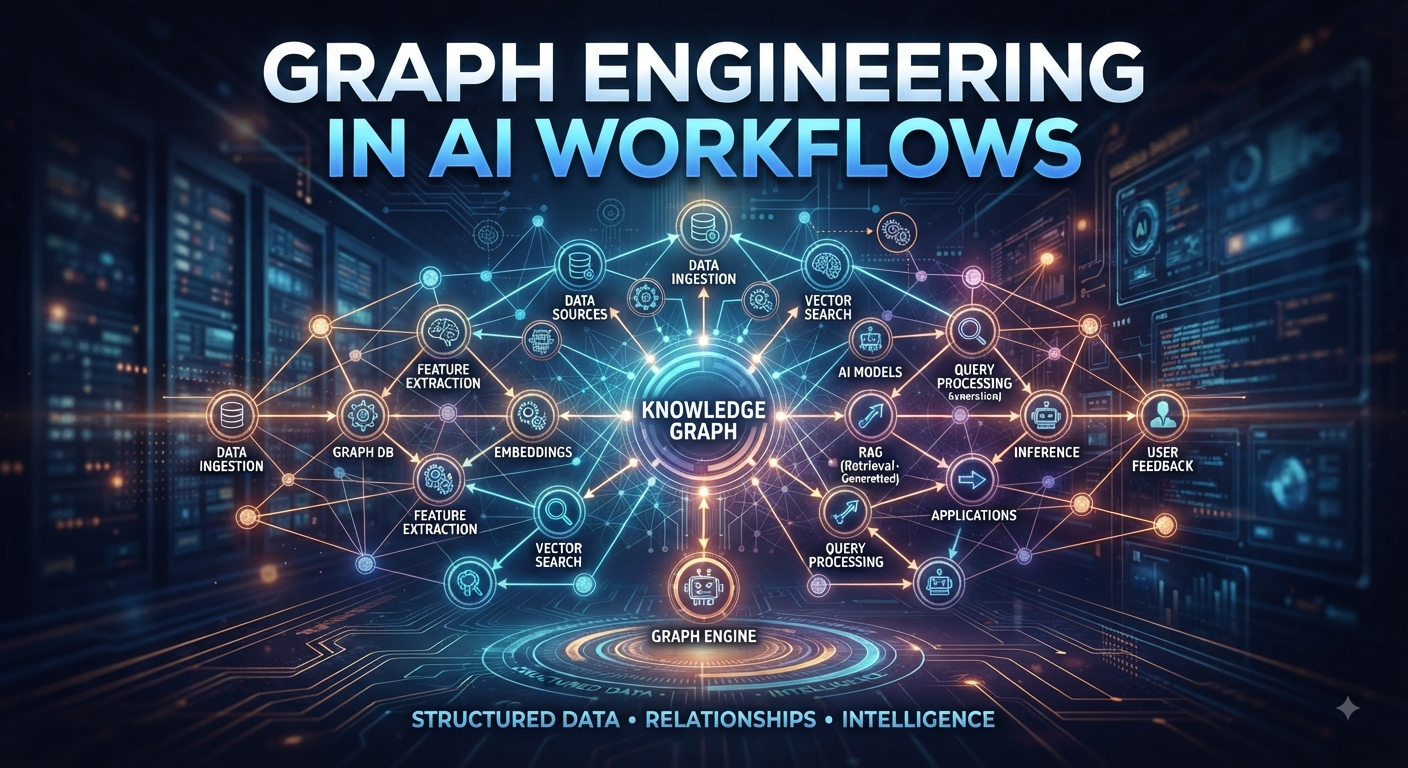
If you’ve built an AI agent that goes “do this, then this, then this,” you’ve actually already built a graph. It’s just the most boring kind possible: a straight line where each step only talks to the step next to it. It works — right up until one step fails, and the whole thing has nowhere to go but down.
That’s the problem graph engineering solves. Here’s what it actually means, in plain terms.
Start with the loop
Before graphs, there were loops. A loop is one agent working on one thing, over and over: try something, check if it worked, adjust, try again. Think of an agent drafting an email, then re-reading it, then rewriting the parts that sound off, then re-reading again. Simple, and genuinely useful for a lot of tasks.
But a loop only ever improves one thing at a time. It has no sense of the bigger picture around it.
What a graph actually is
A graph is just a map of your AI work — drawn out so you can see it, instead of buried in a script. It answers two simple questions:
• What jobs need to happen?
• Which job has to wait on which?
That’s genuinely it. Two building blocks:
• A node is one job. One agent, doing one task, taking one input and producing one output. “Research the competitor.” “Write the first draft.” “Check this claim against the source.” Each node does its thing and hands off.
• An edge (the arrow between nodes) is a dependency. It says “this can’t start until that finishes” — or, in more advanced setups, “this needs to watch that and correct it if something’s off.”
A chain of “do A, then B, then C” is a graph with only one kind of edge: strict, one-after-another dependency. The moment you add a second path — say, a fact-checking node that runs alongside your writing node and feeds corrections back in — you’re no longer in a straight line. You’re in a real graph.
Why this actually matters
A single chain has one failure mode: if any link breaks, the whole thing stops, and nothing else in the system knows or cares. There’s no oversight, because there’s nothing else running.
A graph fixes this by letting multiple loops run at once and check each other. One agent researches while another verifies. One agent drafts while another critiques. If a node produces something wrong, a neighboring node can catch it and send it back — instead of the error just propagating silently down the chain to the end.
This is also why “graph engineering” isn’t some brand-new invention, even though it’s having a moment right now. Systems that route work between checking, correcting, and dependent steps have been running critical infrastructure for decades — this just applies the same idea to AI agents. That’s a feature, not a knock against it: it means the pattern is already proven, you’re just applying it to a newer kind of worker.
When you actually need one
Not everything needs to be a graph. If your task really is linear — step 2 can only ever happen after step 1, there’s no branching, and nothing needs independent verification — a simple chain is fine. Don’t add complexity you don’t need.
Reach for a graph when:
• Multiple things can happen in parallel, not just in sequence
• One part of the process should be able to catch and correct another
• The system needs to keep running even if one node’s output is wrong or incomplete
• You’re coordinating more than one agent, not just one agent doing sequential steps
Building your first one
You don’t need special software to start. Grab a piece of paper or a whiteboard tool and:
1. List every job your process needs done — each one becomes a node.
2. Draw the dependencies — which job genuinely can’t start before another finishes. Those become your edges.
3. Look for jobs that don’t depend on each other. Those can run in parallel instead of waiting in line.
4. Add a checking node somewhere that matters — a step whose entire job is to catch mistakes made by another node, and feed corrections back.
That’s a working graph. From there, translating it into code is just wiring up whichever agent framework you’re using so each node calls the next based on the edges you’ve drawn.
The takeaway
A graph isn’t a fancier version of a loop — it’s what you get when you let multiple loops watch and correct each other instead of running blind. If your current agent setup is just a straight chain, you already understand graphs. The only thing left is to break that chain apart, find where checking and parallelism would actually help, and draw the arrows back in.