
How to Build a RAG-Powered Software Factory for Your Team
A coding agent can produce a plausible change while missing the reason the system is built that way. It sees the ticket, a handful of files and the immediate task; your team sees years of decisions, customer needs and dependencies. Without that wider view, engineers become bug catchers and babysitters, spending their attention on generated slop instead of design.
The answer is not simply to give an agent more autonomy. Build a repeatable delivery system around it: clear knowledge, bounded work, reliable checks and deliberate human approval. Retrieval augmented generation (RAG) can provide the knowledge layer that gives agents the relevant big picture for each change.
From coding agents to a software factory
A software factory is an end-to-end, repeatable path from a well-specified unit of work to a clean, reviewed pull request. It is not a machine that removes engineers from software development. It is a way to reduce avoidable hand-offs and context hunting, so engineers can spend more time on strategy, design and the decisions that need judgement.
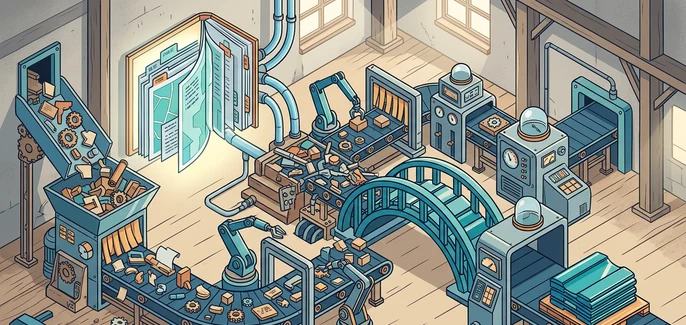
The factory metaphor is useful because it makes the whole workflow visible. A ticket enters with a clear purpose and acceptance criteria. The agent receives the right project knowledge, makes a bounded change and runs checks. The result is reviewed against both technical standards and human intent. Failures are recorded and used to improve the process.
Start with the brakes before the accelerator. If the codebase has unclear boundaries, weak tests or undocumented conventions, automation can make mistakes faster and harder to spot. Classic engineering practices remain the foundation: a shared glossary, architecture decision records (ADRs), a project map, focused specifications, deep modules and enforced boundaries. A small tracer bullet—a thin implementation that crosses the important parts of a system—can help expose missing connections before you automate a larger class of work.
RAG is the missing knowledge layer, not a substitute for those practices. It retrieves relevant material from a maintained collection and supplies it to an agent for a particular task. Rather than paste an entire repository into every prompt, retrieve the glossary, ADRs, specifications, runbooks, relevant tickets and code around the area being changed. The agent then has a better chance of following the team’s intent, and reviewers can see which standards informed the work.
For a broader introduction to this approach, the AI Hero Software Factories for Real Engineers cohort is useful further reading.
Build the factory in seven steps
Keep the first version small and observable. These steps are deliberately sequenced: make knowledge and work legible before adding more automation.
Agree a shared language and document the system. Start with a concise glossary for domain terms that are easy to confuse. Add a project map that explains the main applications, services, data flows and ownership boundaries. Record consequential architectural choices as ADRs, including the context and trade-offs, not only the selected option. Link to existing documentation rather than copying it into new pages that will drift. Choose one representative workflow and identify what an engineer would need to know before changing it.
Create a RAG knowledge layer. Index the sources that explain how the system works: glossary, ADRs, architecture documentation, specifications, runbooks, relevant past tickets and pull requests, and the codebase itself. When a ticket is picked up, retrieve context based on its description, affected files and relevant system area; put those results into the agent’s task brief with source links. Retrieval should help the agent find evidence, not turn every document into unquestioned truth. If sources conflict or a decision is unclear, the brief should surface that uncertainty for a person to resolve.
Keep the index fresh. Re-index changed code and documentation through a repeatable process, and make ownership clear for decisions that are superseded. Preserve links and dates so a reviewer can tell whether a retrieved decision still applies. Retrieval should also respect repository and document permissions: an agent must not receive context merely because it is technically searchable.
Make specifications and tickets agent-ready. A useful ticket states the problem, intended outcome, boundaries, acceptance criteria and relevant constraints. Include examples of expected behaviour and name what should not change. For instance, a ticket about adding a field to an internal workflow might specify which existing records must remain compatible, where validation belongs and how errors should be handled. Let retrieval suggest related documents and files, but require the ticket owner to confirm that the context is relevant. A vague ticket does not become a good one simply because an agent can retrieve more material.
Set coding standards and guardrails. Make important rules executable where possible: tests, linters, type checks, formatting and custom lint rules can catch repeatable violations. Define boundaries that prevent accidental dependencies between modules, and give the agent a narrow scope for its first tasks. Keep instructions concise and version-controlled; a long prompt that tries to explain every exception is difficult to maintain. When an agent repeatedly misses a rule, decide whether the durable fix is a test, a clearer boundary, a better example or a documentation change.
Use three layers of review. First, run automated checks for correctness and consistency. Second, use automated adversarial review to look for likely defects, missing edge cases, security concerns and conflicts with retrieved standards or ADRs. Ground that review in the relevant sources, and ask it to point to evidence rather than make unsupported claims. Third, require human review of a readable pull request. Keep changes small, describe the intent and trade-offs, link the ticket and surface the retrieved context. Automated review can miss subtle domain consequences, and it can also flag harmless differences; it does not replace accountable approval.
Orchestrate work through the tools your team already trusts. A CI workflow, such as one built with GitHub Actions, can help triage eligible tickets, assign or delegate bounded tasks, track status, run checks and request review. Automate transitions only when their conditions are explicit. For example, a failed test should return work for correction rather than silently mark it ready. Keep an audit trail of what the agent received, what it changed, which checks ran and who approved the result. Start with suggestions and human confirmation before allowing workflows to take consequential actions automatically.
Measure the workflow and improve it in retrospectives. Review a sample of completed work with the engineers involved. Ask where context was missing, which retrieved sources were useful, what review caught and whether the ticket was genuinely well-scoped. Track practical signals such as rework, review effort, failed checks and recurring categories of defect, using your own baseline rather than borrowed targets. Retrospectives should improve the factory—documentation, retrieval, boundaries and checks—not merely discuss the latest code change.
Practical decisions before you scale
Choose a safe starting point. Begin in a sample repository or a low-risk area with meaningful tests and an engineer who understands the workflow. Pick work that is repetitive but still easy to review, such as a contained change with clear acceptance criteria. Avoid starting with production incidents, sensitive data paths or broad architectural changes. Expand only after you can explain how an agent got its context and how the team will catch a bad result.
Budget for context, not just generation. Retrieval quality matters more than returning a large pile of documents. Irrelevant context can distract an agent, while oversized prompts consume token budget and make important constraints harder to notice. Tune retrieval using real tickets: inspect what it returned, note what it missed and adjust chunking, metadata or search rules. Do not assume that a more elaborate vector database is the first improvement needed; clearer documents and useful links may solve the problem more simply.
Treat security as part of retrieval design. Apply permissions at retrieval time, keep secrets out of indexed content, and review how source code and documents are sent to the model provider you use. Restrict agent credentials to the work they need to perform. Log enough to investigate failures without unnecessarily copying sensitive material into prompts or long-lived traces. RAG does not make private data safe by itself, and retrieved text can contain stale or misleading instructions. Treat it as evidence to evaluate, not authority to obey.
Keep people in the loop where consequences matter. Agree which changes may be drafted automatically and which need an engineer to plan, implement or approve each stage. Human approval is particularly important when changes affect security, data integrity, customer-facing behaviour or irreversible operations. The right boundary depends on your system and the cost of a mistake; do not widen it just because a workflow can be automated.
Plan for adoption as well as tooling. Engineers need to understand what the system retrieves, how to correct it and when to disregard its suggestions. Invite them to improve the glossary, documentation and review rules. If the process makes pull requests less readable or adds another opaque layer, it is not yet a better factory. Keep the workflow understandable enough that someone can diagnose it when retrieval or automation fails.
Make the factory easier to trust
A RAG-powered software factory is not a promise that agents will understand your codebase perfectly. It is a disciplined way to give them relevant context, constrain the work and test the result. The limitation is important: retrieval can surface the wrong document, miss a crucial dependency or repeat an outdated decision. Clear ownership, freshness checks and human review remain necessary.
Act now if your team already has repeatable work, a codebase with a basic quality baseline and engineers ready to improve the workflow. Wait on broad agent autonomy if requirements are routinely unclear, tests are unreliable or nobody owns the architectural guidance. Fix those foundations first.
Presence Digital is an AI engineering studio that can help teams design and build these workflows when they need support. But the best next action is small: choose one low-risk ticket, write down the context an engineer would need, and see whether retrieval and checks can make its pull request easier to trust.
Build the brakes before the accelerator: a useful factory makes good work repeatable, visible and reviewable.
Newsletter
New articles, in your inbox
One email when we publish. No digests and no product pitches. Unsubscribe any time. Privacy policy