
Why Stripe Buying OpenRouter Changes the AI Infrastructure Playbook
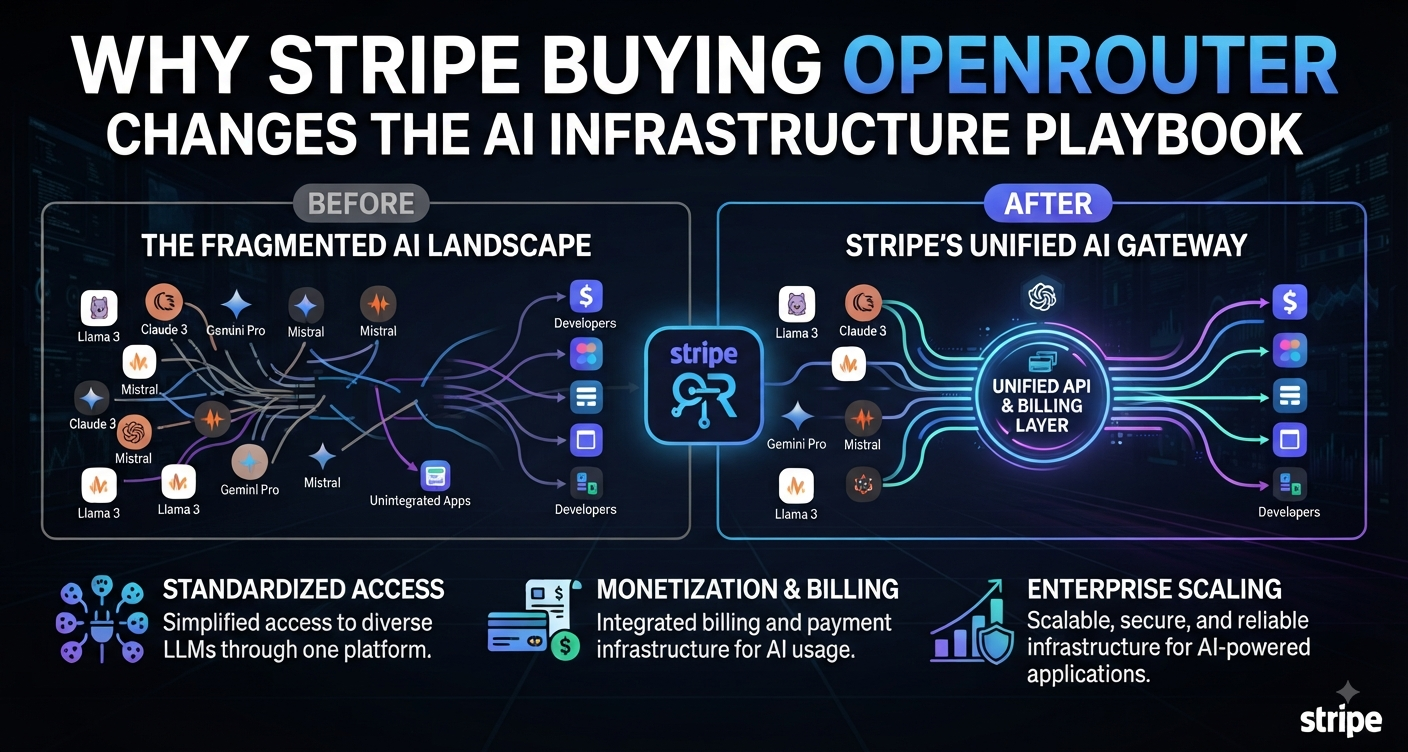
Hardcoding your product to a single LLM provider is becoming a liability. Between fluctuating API latencies, sudden model deprecations, and unpredictable rate limits, relying on one model provider is a single point of failure for production applications. Stripe’s reported $7.5 billion acquisition of OpenRouter, an AI gateway startup, signals a massive shift in how engineering teams must think about their AI stack. The value is no longer just in the frontier models themselves; it is in the infrastructure that routes, manages, and optimizes them.
The Rise of the AI Gateway Layer
For the past two years, developers have treated LLM integration as a simple API call. But as applications scale, the limitations of this approach become clear. Different tasks require different models: a lightweight model for classification, a reasoning model for complex logic, and a highly creative model for copywriting. Managing these credentials, rate limits, and fallback strategies manually creates massive technical debt.
An AI gateway acts as a unified proxy layer. Instead of writing custom integration code for every new model, developers write to a single API. The gateway handles the heavy lifting: routing queries to the cheapest or fastest model, managing fallbacks when an upstream provider goes down, and caching responses to keep latency low. OpenRouter proved that developers want a single, unified interface for AI—much like Stripe did for global payments.
Why Stripe is Betting Big on Abstraction
Stripe’s core business has always been about abstracting away complexity. They turned fragmented global banking rails into a clean, developer-friendly API. By acquiring OpenRouter, Stripe is applying the exact same playbook to the fragmented world of artificial intelligence.
For engineering leaders, this acquisition is a validation of the multi-model approach. Relying on a single AI lab leaves your product vulnerable to their pricing changes and downtime. By decoupling your application logic from the underlying model provider, you gain the leverage to swap models instantly based on cost, speed, or performance updates.
What This Means for Your Engineering Roadmap
If your team is still building direct integrations to individual LLM endpoints, it is time to reassess your architecture. To build resilient, production-grade AI features, your roadmap should prioritize three key capabilities:
- Dynamic Fallbacks: If your primary model provider experiences an outage, your system should automatically route requests to an equivalent model without breaking the user experience.
- Cost and Latency Optimization: Route simple queries to cheaper, faster open-source models while reserving expensive frontier models for complex tasks.
- Unified Logging and Observability: Centralize your prompt tracking, token usage, and latency metrics across all providers to identify bottlenecks early.
At Presence Digital, we help engineering teams design and build these resilient, multi-model architectures. By implementing clean abstraction layers and intelligent routing, we help teams move faster, cut API spend, and eliminate vendor lock-in.
The Takeaway for Builders
The model wars are far from over, but the infrastructure layer is hardening. Winning teams will not be those who bet everything on a single model, but those who build the most flexible, resilient pipelines to orchestrate them. Stop hardcoding your AI integrations and start building for a multi-model future.