
When Does AI Stop Being “AI”?
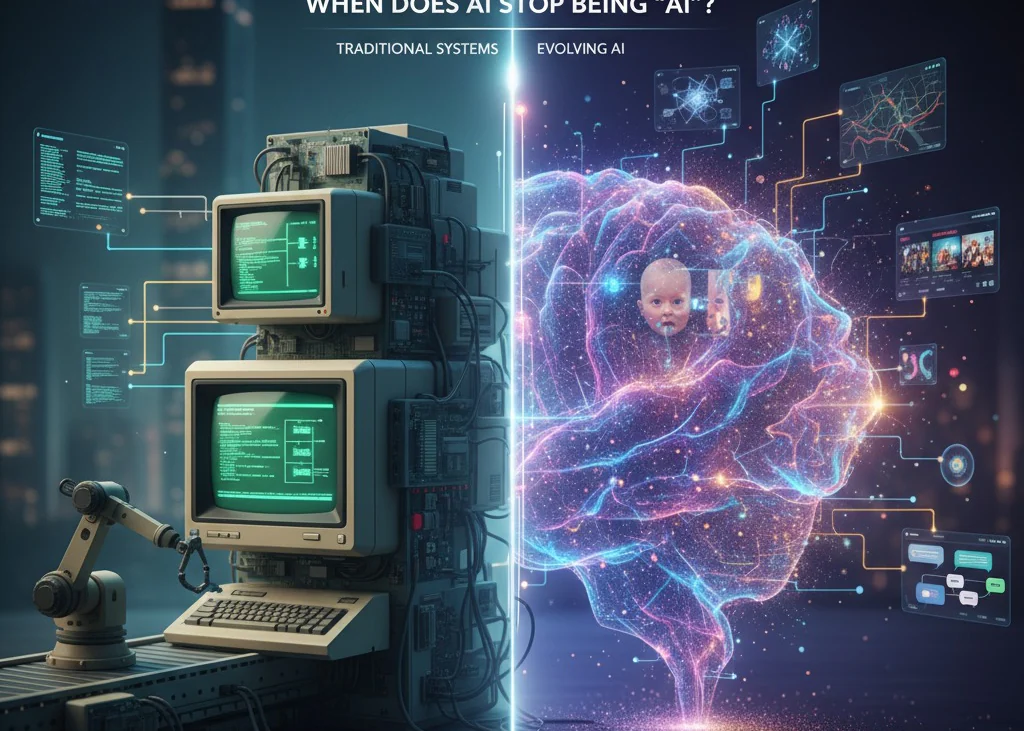
We often hear about artificial intelligence as if it’s some mysterious, futuristic technology. But there’s an important distinction that many people overlook.
Traditional Systems vs. AI
Earlier systems were designed to do one very specific job. They followed a straight, pre-coded path to get the result. In other words, you knew exactly what the system would do and how it would do it.
AI, on the other hand, is fundamentally different. It doesn’t just execute a fixed set of instructions. Instead, it can adapt, learn patterns, and figure things out without being explicitly told how to move from point A to point B.
AI as a Growing Capability
AI isn’t a tool you “finish building.” It’s a capability that keeps expanding. Unlike older systems that eventually plateaued and became part of the background tech we take for granted, AI is too dynamic, too transformative, and evolving far too quickly to ever truly settle into being “just tech.”
The Analogy of Growth
A simple way to think about it is comparing a baby to your older self. The difference is in how much you’ve evolved over time. That’s what AI will do: keep growing, developing, and evolving beyond what we can currently imagine.
The Takeaway
So, when does AI stop being AI? The short answer: it probably won’t. While individual AI applications may become familiar and feel like “just technology,” the field as a whole is constantly advancing. Its ability to learn, adapt, and evolve ensures it will remain distinct, dynamic, and transformative for the foreseeable future.