
Why SpaceX Bought Cursor: The Era of Proprietary AI Stacks
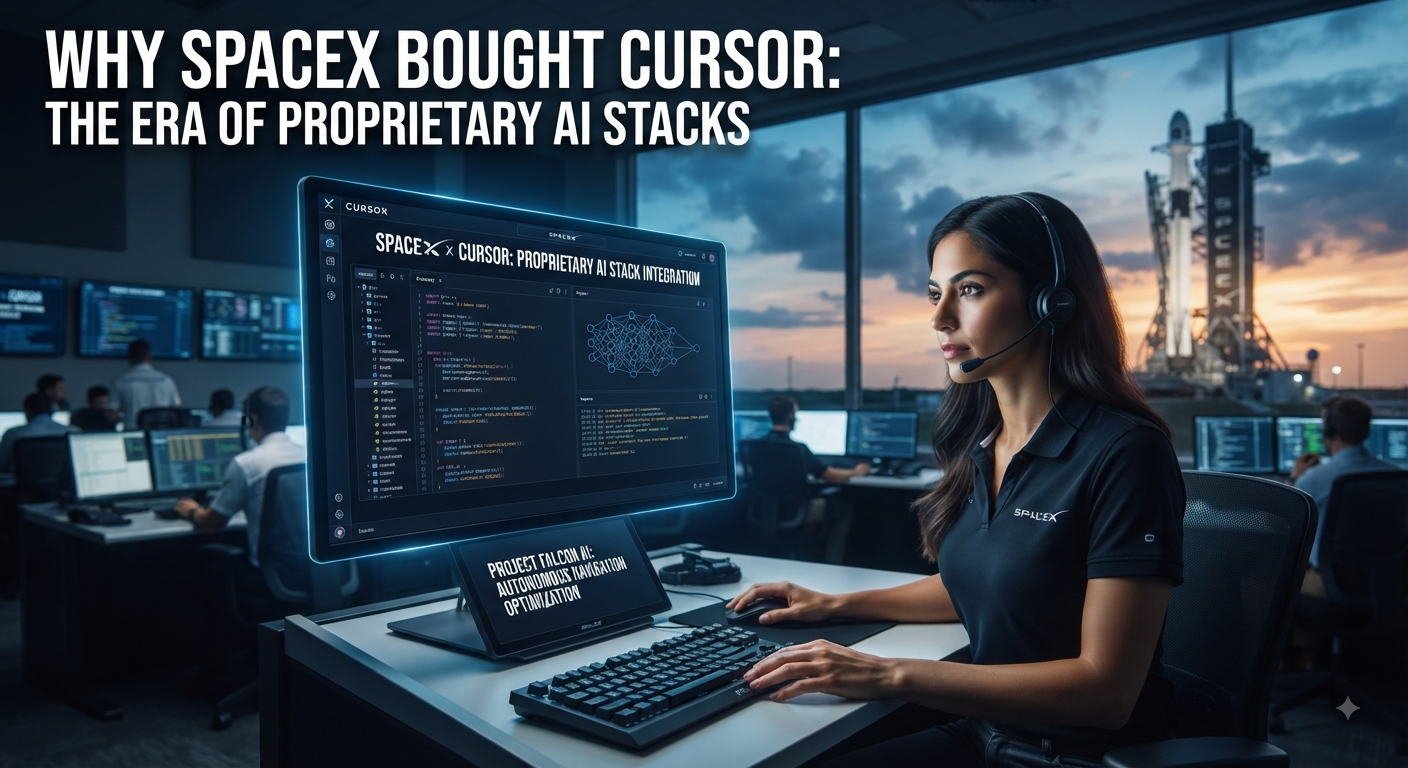
A space exploration giant acquiring an AI code editor isn't a random side-quest; it is a structural warning to every engineering leader still relying on generic, off-the-shelf developer tools. With SpaceX officially closing its acquisition of Cursor, the narrative around AI-assisted development has permanently shifted from lightweight productivity hacks to deep, proprietary infrastructure control.
The Sovereignty of the Developer Environment
For high-stakes engineering organizations, relying on public cloud APIs to autocomplete mission-critical code is a non-starter. SpaceX operates under strict regulatory frameworks, where a single leaked line of telemetry code or an unvetted dependency can compromise national security or delay a launch. By bringing Cursor in-house, SpaceX gains absolute control over the developer environment.
This acquisition is about more than just data privacy. It is about building an air-gapped, highly specialized context engine. When your engineers are writing software for real-time embedded systems, rocket guidance, and orbital mechanics, generic LLMs trained on public web repositories are of limited use. They need an editor that understands their private APIs, legacy hardware constraints, and internal safety protocols without ever leaking that data to the outside world.
The Limits of Generic Copilots
Most engineering teams are still treating AI coding assistants as glorified autocomplete. They install a generic extension, accept the default settings, and hope for a marginal boost in velocity. But the real value of agentic engineering lies in deep context integration.
Owning the IDE allows for structural optimization that a simple API wrapper cannot match:
- Custom Context Engines: Feeding entire proprietary codebases, architectural blueprints, and historical bug databases directly into the model's local context window.
- Tailored Linter and Compiler Loops: Automatically validating AI-generated code against custom, company-specific compilation targets before the developer even hits save.
- Eliminating Model Lock-in: The freedom to swap out underlying LLMs or run highly optimized, fine-tuned local models directly on developer workstations.
The Playbook for Modern Engineering Teams
You do not need SpaceX's budget to adopt this mindset. The takeaway for founders and technical leaders is clear: the era of copy-pasting code into public web interfaces is ending. To maintain velocity and protect intellectual property, you must begin treating AI developer tools as core, proprietary infrastructure.
This means moving away from generic, unmonitored tools and moving toward structured, secure developer environments. At Presence Digital, we help engineering teams design and implement these highly optimized, secure automation pipelines, ensuring your proprietary knowledge remains an asset, not a liability.
The Bottom Line
SpaceX didn't buy Cursor to build a better text editor; they bought it to accelerate their path to Mars by removing friction from the software delivery loop. If the most advanced engineering organization on Earth views developer toolchains as a strategic asset worth acquiring, it is time to re-evaluate how your own team writes, tests, and secures its code.